
Apex Records and Public Access
Apex is a town, not the county seat, so its government records do not sit at one counter. Town departments keep files created through municipal work. Wake County offices in Raleigh keep land, tax, court, estate, and many local vital files. North Carolina agencies maintain statewide systems. Start by identifying the level of government that made or received the record. That one choice prevents many failed requests.
| Apex record set | Official custodian | Online starting point | Access route |
|---|---|---|---|
| Town minutes, contracts, and correspondence | Apex Clerk or creating department | Agenda and document center, when posted | Online, inspection, or Town request |
| Police incident, arrest, CAD, and audio material | Apex Police Department | Voluntary request worksheet | Request; statutory limits apply |
| Deeds, liens, plats, and assumed names | Wake Register of Deeds | CRPI and ROD Self-Service | Index, image, counter, mail, or certified order |
| Parcel assessments and tax bills | Wake Tax Administration | Real Estate Search and tax billing search | Free web view; email or phone fallback |
| Civil, criminal, estate, and special proceedings | Wake Clerk of Superior Court | NC eCourts Portal | Portal, courthouse kiosk, or case file |
| Birth, death, marriage, and divorce records | Wake ROD, Wake Clerk, or NC Vital Records | Application portal, not an open name index | Eligibility, identification, and fees apply |
North Carolina law opens many government records but not every field within them. Sealed court matters, juvenile and adoption files, protected addresses, Social Security numbers, and restricted motor-vehicle data stay outside an ordinary request. Vital certificates have separate eligibility rules. An open index entry also does not guarantee that every linked image or exhibit is public. The custodian may redact protected details while releasing the rest.
Search Wake Deed Records
The Wake County Register of Deeds operates two electronic paths for land-related Apex records. The Consolidated Real Property Index, or CRPI, exposes search modes for name, book and page, date, document type, map, and advanced criteria. ROD Self-Service begins with a disclaimer and search entry. Wake warns that an index works like a library card catalog. It points to an instrument, but the recorded document remains the source.
| Search control | What to enter | Best Apex use |
|---|---|---|
| Name | Grantor, grantee, surname variants, initials, or entity | Find transfers and liens tied to a person or firm |
| Book and page | Recorded book and page reference | Open a cited instrument directly |
| Date | Recording date or range | Narrow common names and recent filings |
| Document type | Deed, deed of trust, plat, or other exposed type | Separate ownership records from financing or maps |
| Map or advanced | Available parcel, party, and record criteria | Refine a broad Apex result set |
Search both directions. A grantor gives or transfers an interest; a grantee receives it. Spouse names, business entities, initials, and small spelling changes can create separate index paths. Digitized Wake books include eighteenth-century material, but the portal does not state one start year for every series. If a book or name is absent, ask the Register of Deeds counter about unindexed volumes rather than treating the web result as final.
The Wake Consolidated Real Property Index shows how search modes and historic projects are organized.
Its separate links for pending documents, unique names, and historical work make the chosen search path part of a sound record check.
Apex Property Records Across Systems
Four Wake systems describe different parts of an Apex property. The Real Estate Search shows the assessed owner, the situs address where the parcel sits, the tax mailing address, value, sale history, and parcel identifiers. The tax-bill system adds billed ownership, jurisdictions, levy, and payment information. Official help describes online bills from 1994 forward. iMAPS supplies parcel shape, municipal jurisdiction, districts, and other map layers. The deed index supplies the legal transfer.
Those files are related, not interchangeable. A mailing address may identify a nonoccupant owner, while a situs address identifies the land. A parcel ID is not a deed book and page. An Apex postal address may also fall outside Town limits. Check the parcel and jurisdiction before asking Apex for a permit or code record. Later subdivisions often rely on lot, block, plat, and real-estate identifiers that are more stable than a street label.
Keep the identifiers. Save the parcel ID, deed book and page, document ID, and case number when shown. Each Apex record system uses its own key.
Note: The 1994 start applies to Wake's online tax-bill help, not to every parcel, deed, or assessment series.
Apex Court Records Access Layers
Apex has no separate municipal court. Wake County Superior and District Courts, part of Judicial District 10, handle local state-court matters. Superior Court covers felonies, larger civil matters, and District Court appeals. District Court covers misdemeanors, infractions, smaller civil matters, domestic cases, and juvenile matters. The Wake Clerk also keeps estates and special proceedings, including public filings that may connect a decedent with heirs.
The NC eCourts Portal accepts a party or business name, case or record number, citation, attorney, bar number, cross-reference, or nickname through Smart Search. Filters can narrow location, category, date, and status when available. Results may show the case number, parties and roles, attorneys, filing date, events, hearings, status, and judgments. A portal docket is a summary, not always the complete file.
- Use the Portal for remote case and party information.
- Use a courthouse Public Access Kiosk for on-site criminal, civil, estate, and special-proceeding searches.
- Ask the Wake Clerk for the paper or electronic case file by case number.
- Use the county of entry for a divorce judgment copy.
Juvenile, adoption, sealed, and expunged matters do not appear as ordinary public cases. Protected exhibits and personal identifiers may also be withheld from an otherwise open file. In North Carolina, “expunction” is the statutory term for removal. A blank search result cannot prove that no matter ever existed.
Vital Records for Apex Events
Vital records use a controlled certificate process rather than an unrestricted people index. The Wake Register of Deeds issues local birth, death, and marriage certificates for Wake events. The Wake Clerk supplies the actual divorce judgment. NC Vital Records registers births, deaths, fetal deaths, marriages, and divorces statewide. Under Chapter 130A, Article 4, especially G.S. 130A-93, certified copies generally require a qualifying relationship or legal right. The named person, spouse, sibling, ancestor, descendant, certain step-relations, authorized representative, or legal-right claimant may qualify. Identification and current application rules still apply. North Carolina does not use a simple rule that all births open after one span and all deaths after another.
The North Carolina Vital Records service page separates event types and application routes.
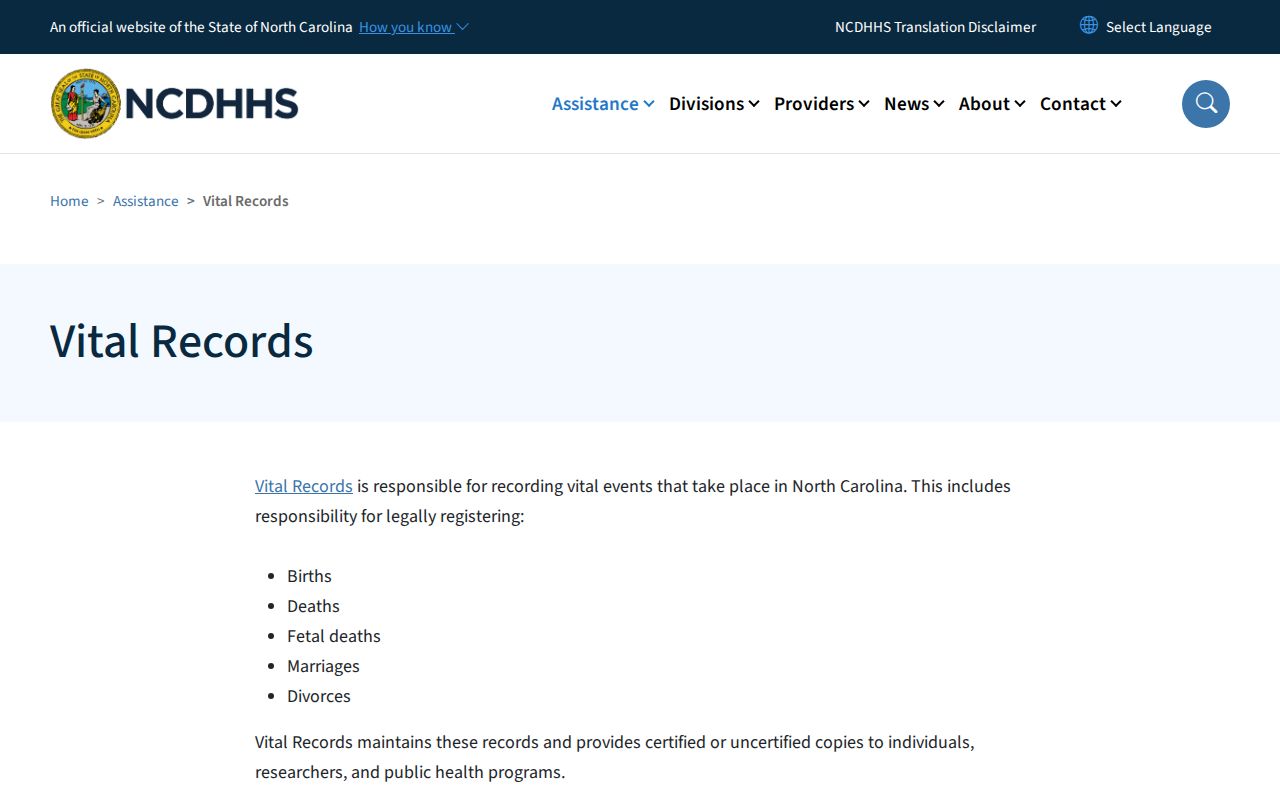
That separation matters because a certificate order, a county index reference, and a court judgment are distinct records with different custodians.
Older proof may come from marriage bonds, county books, church registers, cemetery files, newspapers, delayed registrations, or State Archives holdings. Those sources can support family history, but they do not replace a certified certificate when an official copy is required.
Apex Law Enforcement Records
The Apex Police Department uses a voluntary records worksheet for incident reports, arrest reports, CAD reports, 911 calls, radio traffic, and other identified material. CAD means computer-aided dispatch, the system used to log calls and responses. Helpful fields include the report or CAD number, incident location, date and time, and an audio time range. The form says it may take up to 10 business days. That is an agency processing notice, not a statewide Chapter 132 deadline.
Body-worn and in-car video are excluded from that worksheet and follow G.S. 132-1.4A. Criminal investigative material is limited under G.S. 132-1.4, although specified arrest and event facts remain public. A narrow request can help the custodian separate releasable facts from protected investigative content. The form is not mandatory, so a requester can still write or contact the proper records unit.
Custody records have separate state and county paths. Wake Sheriff channels address current detention information when no public name result appears. The NC Department of Adult Correction public search covers releasable conviction and custody data, not every arrest. The state offender registry covers only the statutory registration population. An absent result in either system has that limited meaning.
Apex Public Records Custodians
Office boundaries matter more than physical distance. Apex Town Hall is the correct first stop for Town-created files. Wake County offices hold the main deed, court, estate, parcel, and local certificate systems. Many counters are in Raleigh because Raleigh, not Apex, is the Wake County seat. Use the named portal for an initial check, then contact the office when an image, older volume, certified copy, or full case file is missing.
Wake Register of Deeds
Wake County, Raleigh
Deeds, plats, assumed names, and certificates
The Wake Register of Deeds self-service entry presents the search terms and disclaimer before record access.
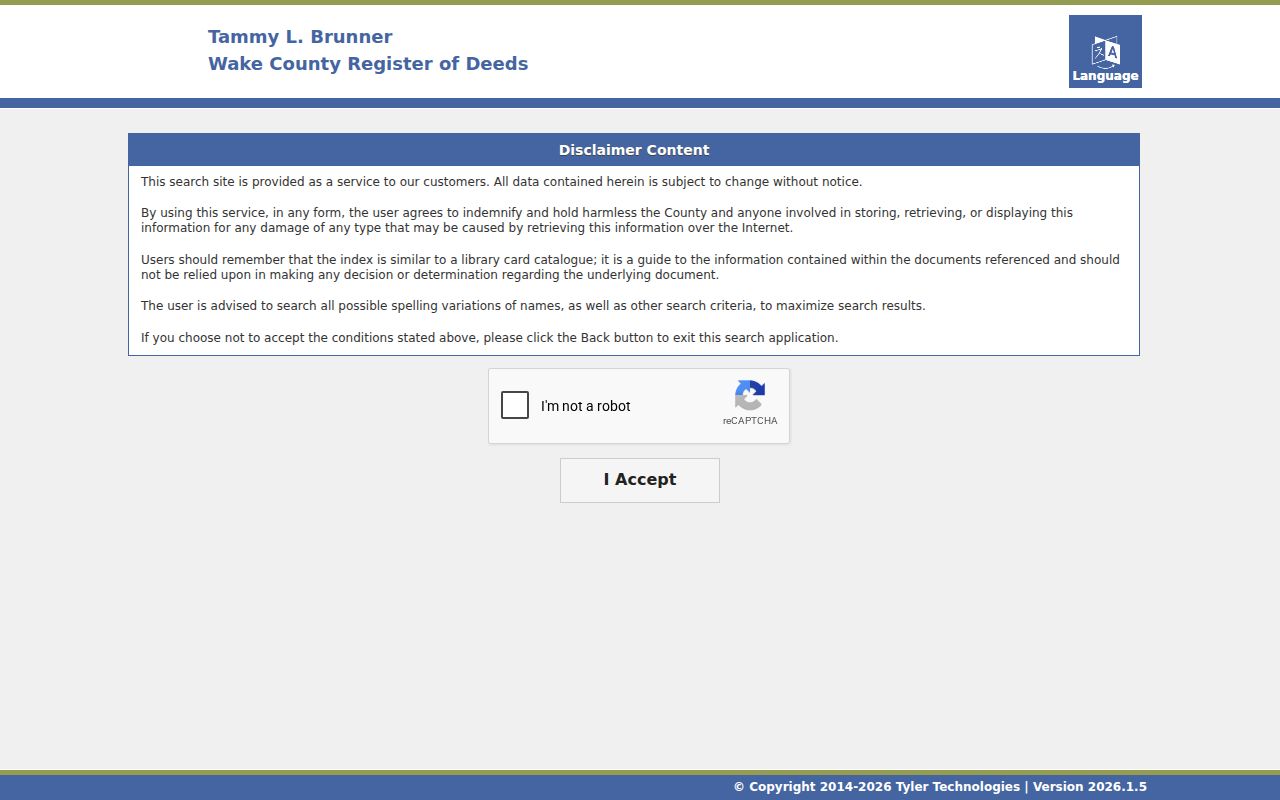
The notice reinforces why a portal match should be tied back to the actual instrument and, when needed, an official certified copy.
North Carolina Records Law in Apex
G.S. 132-1 defines public records broadly when material is made or received in public business, regardless of physical format. G.S. 132-6 permits inspection at reasonable times under reasonable supervision by any person. A requester does not have to live in North Carolina or explain a purpose. The law calls for copies “as promptly as possible,” with no universal three-, five-, or ten-day deadline.
G.S. 132-6.2 lets a requester choose a medium an agency can provide. Ordinary uncertified charges cannot exceed direct actual reproduction cost unless another law sets the amount. Existing staff and overhead are not part of that direct cost. An agency may assess a reasonable special service charge when a request needs extensive information-technology resources or extensive clerical or supervisory help. Discuss the estimate and a narrower scope before the work begins.
- Custodian
- The office responsible for keeping and releasing a record.
- Index
- A finding aid that points to an underlying document but may not reproduce it.
- Certified copy
- A copy formally authenticated by the issuing office.
- Exemption
- A legal rule that closes a record or requires protected parts to be withheld.
If access is denied, ask for the exact statutory basis and for any separable public portion. G.S. 132-9 provides court enforcement through mandamus or injunction. Many confidentiality limits expire after 100 years under G.S. 132-11, but that rule does not open court-sealed matter, federally barred data, Social Security numbers, protected juvenile files, or sensitive infrastructure plans.
Apex Record Fees and Copies
Costs depend on both the record and the copy type. Viewing an index or inspecting a file may be free while certification costs extra. For a Wake recorded instrument, G.S. 161-10 sets $5 for the first certified page and $2 for each added page or fraction. A certified plat is $5. Those copy charges should not be confused with recording fees paid when a new instrument is filed.
| Record or service | Published charge or rule |
|---|---|
| Wake certified recorded instrument | $5 first page; $2 each additional page or fraction |
| Wake certified plat | $5 |
| State vital-record search | $24 for one three-year search, including one copy if found |
| Additional same vital certificate | $15 each |
| Court document preparation | $2 first page of each document; $0.25 each additional page |
| Court seal certificate | $3 |
Vital Records treats the $24 search payment as nonrefundable, even when the record is not found. Another three-year period triggers another search charge. Expedited handling, shipping, and third-party order costs are separate and should be checked against the current official fee page. For a large Apex request, inspect first and request an estimate before committing to extensive-service work.
Apex Deed Alerts and Limits
Wake County's Document Recording Alert is a timely, free way to watch for a matching name in a newly recorded document. Registration creates a notice route. It does not stop a filing, decide whether an instrument is valid, or replace title and legal review. That distinction is vital when a mailer or caller uses a real owner name, parcel reference, or deed book and page to appear official.
The Wake Document Recording Alert registration states the service's supplemental role.
The screen offers notification help, but any suspicious Apex recording still needs review through the Register of Deeds and the underlying instrument.
Be cautious with deed-copy solicitations that sell an “official” copy for far more than the county schedule. Compare the letter with the Wake ROD domain and current fees. Unclaimed-property claims can likewise be checked free through official NCCash before paying anyone. Public access is useful for scam checks, but it is never permission to threaten, follow, stalk, or harass a person.
Requesting Apex Public Records
A precise request helps the Town, county, or state custodian locate the right material without sweeping in unrelated files. Include the record type, date range, person, address, project, event, case, instrument, or parcel identifier that is already known. State the preferred format. Chapter 132 does not require a special form or a purpose statement, even when an office provides a form for convenience.
- Identify the office that created or keeps the Apex record. Confirm municipal jurisdiction when an address is the only starting point.
- Check the official index first. Save stable metadata such as a case number, parcel ID, book and page, or document ID.
- Send a narrow request through the office portal, email, mail, or counter. Ask to inspect first if the volume is unknown.
- Request the available native electronic format and ask for a cost estimate before extensive work or certification.
- If access is denied, ask for the statute, the separable public parts, and review by the custodian or agency counsel.
Online posting may satisfy access when the record can be viewed, printed, or saved. It does not erase offline channels. The counter, mailed application, courthouse kiosk, paper file, library, and State Archives remain important when Apex material predates an index, needs certification, or belongs to a series not imaged on the web.
Use records lawfully. Apex public records support family research, estate work, civic review, and fraud checks. Do not use released information to stalk, harass, threaten, or harm anyone.