
Apex People Directory Landscape
Apex people directories are not one master list. Each records a defined group for a specific purpose. The Town list is best for a department contact. School and campus tools identify public staff by role or site. Wake County land systems name owners and deed parties, while state tools show agency contacts, regulated professionals, and public company roles. For an earlier resident, Olivia Raney Local History holds the most useful directory and newspaper collections.
| Directory source | People included | Keeper | Access route |
|---|---|---|---|
| Apex staff directory | Town staff by name or unit | Town of Apex | Free web search; department or Clerk fallback |
| NC Employee Directory | State agency staff | NC.gov | Free name and agency search |
| WCPSS and Wake Tech directories | School, district, faculty, and campus staff | Each education system | Free web search; school or unit contact fallback |
| Wake land and voter indexes | Owners, deed parties, and registered voters | Wake County and NCSBE | Free portals; office fallback for record gaps |
| State business and license lists | Company agents, officers, and licensees | Secretary of State and licensing boards | Free official lookups; board-specific details |
| Polk, Hill, and newspaper holdings | Dated residents, firms, and named local people | Olivia Raney Local History | Catalog discovery and staff-assisted use |
Pick the list that fits the relationship. A Town role points to the Apex staff search. A school name calls for WCPSS. An address may lead to the Wake owner roll, but ownership does not prove who lives there. A former resident calls for dated directories, newspapers, yearbooks, or deed records. These lists overlap, yet each has its own omissions and date.
Search the Apex Staff Directory
The official Apex staff directory searches by unit or name. Category is useful when the exact spelling is unknown because it narrows results to Administration, Building Inspections, Clerk, Police, Planning, Public Works, Utilities, and other Town units. JavaScript must run for the entry list to appear. A blank page may therefore reflect a browser setting rather than a missing staff member.
| Search label | Control | Required | How to use it |
|---|---|---|---|
| Category | Dropdown | No | Choose a Town department or division |
| First Name | Text | No | Enter the staff member's given name |
| Last Name | Text | No | Enter the staff member's surname |
| Search | Button | Not applicable | Submit the chosen filters |
Department results can provide a street address, main telephone and fax numbers, a unit page, and a table of staff. If the dynamic list fails, call the department main line. Town Hall can route a request at 919-249-3400, and the Office of the Town Clerk is available at 919-249-1260. A formal request is a later option for a public field that is not already posted; the broader access process belongs with Apex public records.
Note: Personal files are not staff-directory records, and a public work contact should be used only for a lawful purpose.
Apex Government Directory Routes
The Town directory and the statewide list cover different levels of government. A typical Apex entry includes a name, unit, title, email link, direct telephone number, and sometimes an added phone. The inspected staff sample identifies Michael Iglesias in Building Inspections & Permitting as Building Code Official II and provides a direct number. Department views add the shared office details needed when one person is unavailable.
- Name: surname and given name in the individual row
- Role: published title tied to a Town unit
- Department: service area and department page
- Email: work email link when published
- Telephone: direct, additional, or department contact
- Office: department address when supplied
For a state agency contact, use the NC directory instead. Its controls accept first or middle name, last name, and agency. The NC Employee Directory search shown here captures those exact fields.
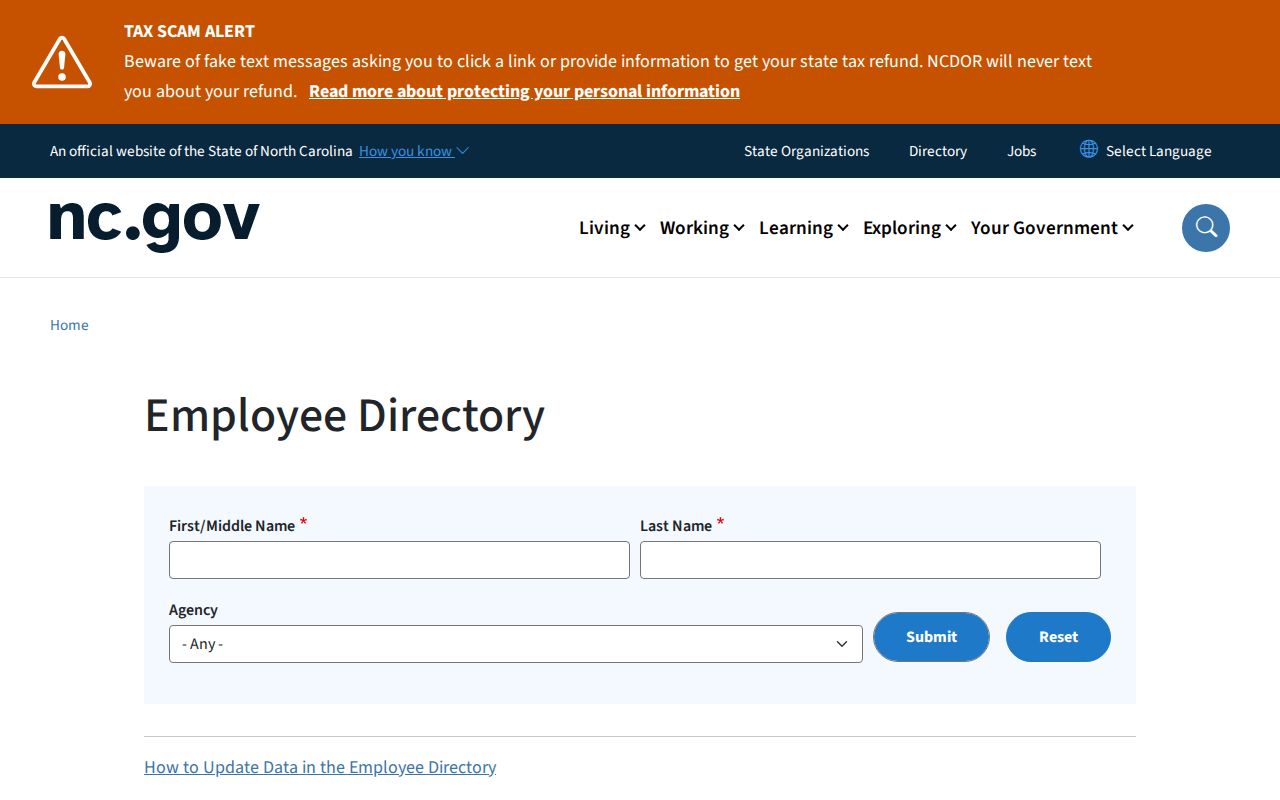
The image shows why agency is a useful filter for common names. If an entry is absent, move to the agency contact page or main switchboard rather than treating the result as proof that no such person serves there.
Apex School and Campus Directories
The Wake County Public School System directory accepts Keyword, First Name, and Last Name. At inspection, it reported 17,041 constituents and showed ten results per page. A result may include the person's name, title, school or site, department, work email, school telephone, and extension. Search a surname first, then use the school or department data to separate people with similar names.
Wake Tech's faculty and staff directory adds A-to-Z browsing and filters for Department, Division, and Campus, along with first and last name. Its results can show a linked name and email, title, department, campus, building and room, and office phone. The campus filter matters around Apex because a college contact may work at one of several sites. When a result has aged out, the school office, district unit, or college department is the sound fallback.
No authoritative public alumni-member directory was found. Yearbooks and institutional archives can document former students, but access to a private alumni roster should never be assumed.
Apex Land and Civic Directories
Wake land systems act like dated people directories. The Wake Real Estate Search can begin with owner name, street address, or parcel identifier. A parcel card can show the listed owner, physical or situs address, tax mailing address, values, property details, sale history, and legal identifiers. The mailing address may lead to an owner who lives elsewhere. It must not be read as the property occupant.
The Wake Consolidated Real Property Index lists grantors and grantees. A grantor transfers an interest; a grantee receives it. Search both roles, plus initials, spouse names, entity names, and spelling variants. The portal itself compares its index to a library card catalog, so the linked instrument supplies the full context. Search modes include Book/Page, Name, Date, Document Type, Map, and Advanced Search. Pending documents and available images are online, while unindexed books and copy needs may require the Register of Deeds counter in Raleigh.
North Carolina voter data can also serve as a dated civic directory. The public lookup can connect a name with Wake County, registration status, precinct, and districts, while published voter files include current data and historical snapshots. Protected fields are withheld, and participation history never shows a ballot choice. The voter list also omits nonvoters, so it cannot stand in for a resident directory.
Note: An Apex postal address can fall outside Town limits, so confirm parcel jurisdiction before choosing a permit or land-record office.
Apex Business and License Directories
The North Carolina business search works as a directory of public company roles. It can search an entity, official, or registered agent with matching controls for an organization or a person's last, first, and middle names. A profile may show legal name, status, formation data, registered agent, office and mailing addresses, officer names and titles, filing history, and document links. These are company filing roles, not a complete list of everyone tied to the firm.
For an assumed business name, the statewide search covers filings from December 1, 2017. Older certificates remain with a Register of Deeds, and a filing may name Wake County, several counties, or all counties. Search the state system, then ask Wake about a legacy name when no current match appears. Certified copies come from the office that filed the certificate.
The state's professional license directory routes to the board that holds each roster. Board searches can verify attorneys, physicians, nurses, real-estate brokers and firms, contractors, cosmetology licensees, and other regulated roles. Fields vary, but often include a person's name, credential or license number, status, contact or practice address, and public actions. The board record is the authority for its own credential.
Apex Names Restored From Deeds
One Wake index reaches people whom the normal grantor-grantee directory often concealed. The official Wake Enslaved Persons Search extracts names found inside historic instruments. Its search modes include All, Date, Book, Page, Grantor, Grantee, and Enslaved Person's Name. Result rows provide record ID, date, book, page, document ID, deed parties, and the enslaved people listed.
The observed directory contained 2,156 items on 144 result pages, including entries from the 1780s. That scale makes the project more than a deed shortcut. It restores a direct name path into documents that once indexed only the people treated as parties to the instrument. Try spelling variants and read the linked deed image because names, relationships, places, and legal context may appear beyond the result row.
Apex Library Directory Holdings
Olivia Raney Local History in Raleigh is the main Wake County library repository for old directories, microfilm, yearbooks, vertical files, and local newspapers. Many items do not circulate or carry a Consult Staff label. Catalog searches can use keyword, title, start of title, series, author, or subject, then narrow by date, collection, format, branch, and availability.
| Holding | Published coverage | People details | Best access |
|---|---|---|---|
| Polk and Hill city or suburban directories | Cataloged years begin in 1880-81; broad later runs reach 2020-24 | Resident or firm, address, phone, and often occupation | Search catalog, then confirm the volume with staff |
| Reverse or criss-cross sections | Volume-specific; Apex coverage is not published as one list | Street address, occupant, and nearby listings | Ask staff to inspect the needed year |
| Yearbooks and vertical files | Collection-specific | Students, groups, photographs, and local subjects | Catalog and staff-assisted review |
| Apex and Western Wake Herald | Microfilm begins January 28, 1965 | Family notices, clubs, schools, firms, and addresses | Microfilm at Olivia Raney |
The catalog does not publish one exact list of Apex-inclusive years or identify every volume with a reverse section. Contact staff before making a trip. A surname plus “Apex,” a street, school, cemetery, or newspaper title gives the catalog a more useful target than a surname alone.
Apex Newspaper Directory Since 1965
The cataloged Apex Herald and Western Wake Herald microfilm begins January 28, 1965. Search both titles as a combined run. Local obituaries, marriage and birth notices, school honors, civic clubs, church events, legal notices, and advertisements often name people who do not appear in statewide newspaper indexes. An address or group name can separate same-name residents.
This newspaper run is a directory by event rather than a neat alphabetical list. Begin with an estimated date from a yearbook, deed, cemetery record, or family paper. Then inspect nearby issues and record the title, issue date, page, and column. For earlier Apex lives, broaden the search to Raleigh and Wake newspapers, older directories, deeds, census schedules, church registers, and manuscript collections.
Note: A newspaper notice can connect names and dates, but corroborate key relationships with deeds, vital records, cemetery files, or court records.
Trace Apex Through Historical Directories
Apex grew from a railroad and market town, and its records changed with that growth. Wake County dates to 1771. Apex's rail station was chartered in 1854, the first train passed in 1869, and the town incorporated in 1873. Early evidence may sit in rural land, tax, church, and county sources. Later city and suburban directories add street addresses, firms, phone numbers, and work roles.
The downtown fires of 1905 and 1911 may explain gaps in private photographs, firm papers, and address continuity. They did not establish a loss of Wake courthouse deed or probate books. Modern web portals also do not mark the true start of every series. When a name vanishes online, ask about unindexed volumes, consult an earlier directory, or compare the deed book and newspaper run.
- Dated directory
- A list that shows a person, firm, or address for a stated publication period.
- Reverse directory
- A section arranged by street and number, useful for finding a past occupant and nearby listings.
- Situs address
- The physical property location, which can differ from the owner's tax mailing address.
- Index
- A finding tool that points to a full deed, file, volume, or image held elsewhere.
Private congregation, neighborhood, union, fraternal, and alumni rosters were not confirmed as open Apex people directories. Seek permission from the group. Public substitutes include yearbooks, church or cemetery records that are released for research, meeting minutes, memorial inscriptions, and dated newspaper notices. No verified current local carrier white-pages directory was found, so historical phone and suburban volumes remain the defensible route.